


.jpg)


A hydraulic press works by using pressurized fluid to move a cylinder and ram, converting a small input force into a much larger output force. That's the short answer. The longer answer covers the physics behind it, the parts that make it happen, the different press styles you'll find in a shop, and what actually affects how well a press performs day to day.
What Is a Hydraulic Press?
A hydraulic press is a machine that uses fluid pressure to generate compressive force. In metal fabrication, that force gets put to work forming, bending, straightening, and assembling parts, everything from shaping raw stock to pressing bearings and bushings into place. The appeal is control: a hydraulic press applies steady, adjustable pressure rather than a single mechanical strike, which matters when the part or tooling can't withstand a jarring impact.
How a Hydraulic Press Works
The operating principle is based on one law of physics. Pascal's Law states that pressure applied to a confined fluid is transmitted equally throughout that fluid. In a hydraulic press, that means the pressure created by a small piston is felt just as strongly by a much larger piston elsewhere in the system.
That's where force multiplication comes in.
Since pressure stays constant (Pressure = Force ÷ Area), a small force applied to a small-area piston creates the same pressure that, acting on a much larger piston area, produces a far greater force.
The formula is simple: Force = Pressure × Area.
A modest input force on a small piston can generate tons of output force on a large one, though the trade-off is distance: the large piston moves a shorter distance than the small one travels.
In practice, the process plays out as a press stroke cycle: the pump builds pressure in the fluid; a control valve directs the pressurized fluid into the cylinder; the cylinder extends, and the ram presses into the workpiece; and once the operation is complete, the fluid returns and the ram retracts.
Repeat the cycle, and the hydraulic press applies the same controlled force to the hundredth part as to the first.
Main Components of a Hydraulic Press
- Hydraulic power unit: the motor, pump, and fluid reservoir that work together to supply pressurized fluid to the cylinder. The pump doesn't create pressure directly; it creates flow, and the force builds when that flow meets resistance, such as a workpiece under the ram.
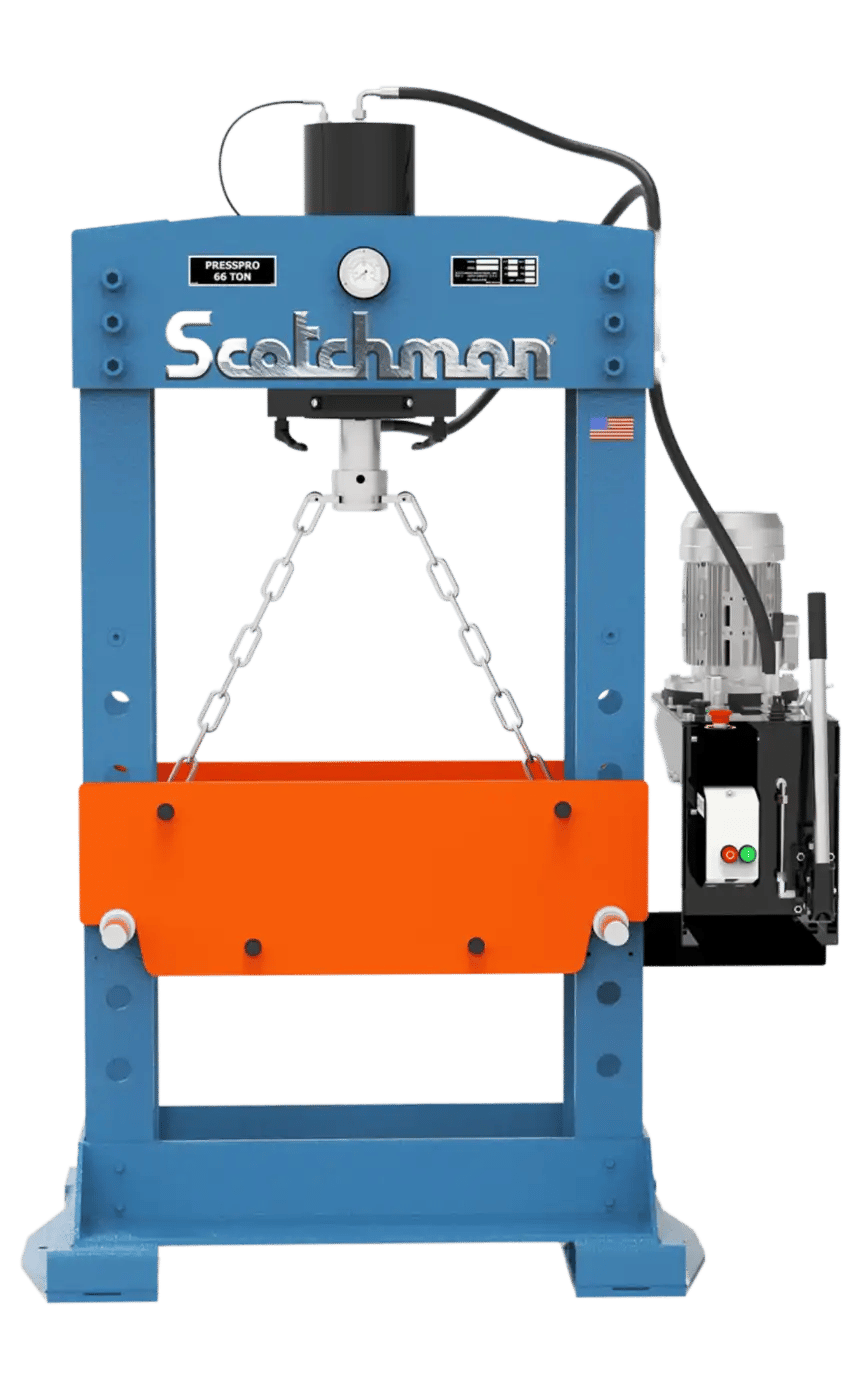
- Cylinder and ram: the cylinder is a sealed tube containing a piston; the ram is the shaft connected to that piston that extends out to press the workpiece. When pressurized fluid enters the cylinder, it drives the ram forward.
- Frame, bed, and tooling: the frame supports the whole system and keeps the ram aligned under load. The bed is the stationary surface that holds the workpiece or die in place.
Tooling, whatever attaches to the ram and bed, shapes, presses, or holds the material for the specific job at hand, whether that's pressing a bearing into a housing or straightening a bent shaft back to true.
Types of Hydraulic Presses Used in Fabrication
Shop press formats vary mainly by frame style, and the right one depends on workpiece size, floor space, and how material needs to be loaded.
|
Frame Type |
Best For |
Notes |
|
H-frame |
General-purpose pressing work |
Most common shop configuration, named for its H-shaped frame with a table and supporting legs |
|
C-frame |
Jobs needing quick side access |
The open-front design lets material be fed in and out fast. |
|
Bench |
Lighter-duty work in tight space |
Essentially a compact, portable H-frame |
|
Roll-frame |
Larger, heavier workpieces |
Heavier H-frame variant with a fixed bolster; the operator moves the press head instead of the material. |
|
Horizontal |
Long stock, tubes, and shafts |
A horizontal hydraulic press presses or straightens material fed in sideways rather than top-down, making it suitable for longer parts that don't fit a vertical frame. |
Drive and control options matter as much as frame style.
- A manual press uses a hand-operated lever or foot pedal to build pressure stroke by stroke, ideal for lower-volume or lighter-duty work where cost and simplicity matter more than speed.
- Air-powered (air-over-hydraulic) presses use shop air to assist the pump, reducing manual effort for moderate-volume work.
- Electric presses use a motor-driven pump to deliver continuous, consistent pressure, making them better suited to higher-volume or heavier repair work where speed and repeatability matter.
No option is universally better here; it depends on the shop's volume, available power, and the work being done. Whatever the drive type, the right hydraulic press accessories, mandrels, V-blocks, and tooling matched to the press model play a real role in getting consistent results.
Factors That Affect Hydraulic Press Performance
A press's rated tonnage is only part of the story. Actual performance also depends on the condition of tooling, ram alignment, hydraulic fluid, and regular maintenance. Pressure and tonnage limits matter most: pushing a press beyond its rated capacity risks damaging the tooling, the workpiece, or the machine itself and creates a real safety hazard for the operator.
Machine guarding is part of both performance and safety. Under OSHA 29 CFR 1910.212, guarding must prevent any part of the operator's body from entering the danger zone during the operating cycle, whether through barrier guards, two-hand tripping devices, or electronic safety devices.
Operators should always adhere to the manufacturer's rated capacity and maintenance schedule, rather than exceeding the press's limits.
FAQ
How do hydraulic presses work?
They use pressurized fluid to move a piston, which drives a ram that applies force to a workpiece. A small input force on a small piston creates pressure that acts on a much larger piston, producing a far greater output force.
What is Pascal's Law in a hydraulic press?
Pascal's Law states that pressure applied to a confined fluid is transmitted equally throughout that fluid. That's why pressure at a small piston can generate a much larger force at a bigger piston elsewhere in the system.
What is a hydraulic press used for in metal fabrication?
Forming, bending, straightening, and assembly work, including pressing bearings, bushings, and pins into or out of parts.
How is a hydraulic press different from a mechanical press?
A hydraulic press applies smooth, adjustable pressure that can be held or varied throughout the stroke. A mechanical press delivers force through a fixed mechanical motion, typically faster but less adjustable mid-stroke.
.png)