


.jpg)


Pick the wrong machine for your shop and you'll either overpay for capability you don't need or underdeliver on jobs that require more control. An ironworker vs. plasma cutter comparison isn't about which machine is better overall. It's about which one fits the work you actually run. Both belong in fabrication shops. They just solve different problems.
What Is an Ironworker?
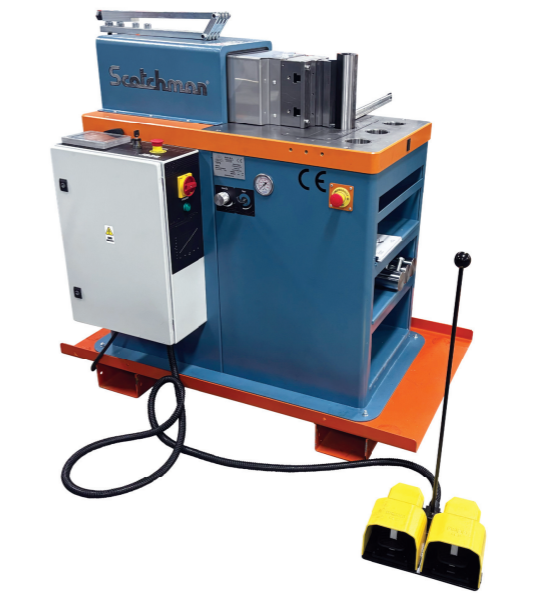
An iron worker machine is a hydraulic multi-function fabrication machine that handles punching, shearing, notching, and bending from a single unit. It applies controlled mechanical force to cut, pierce, and form structural metal without heat, sparks, or fumes.
Punching and Shearing
The punch station drives a punch through a plate and structural material to create clean, burr-minimal holes. The shear station cuts flat bar, angle iron, and plate stock quickly and cleanly, replacing the saw for most straight-cut work on structural profiles.
Notching and Bending
The notching station removes material from corners and edges of flat bars, angle iron, and structural profiles. Many models also include a bending station for forming flat bars and heavy stock.
With the right ironworker tools and a well-configured ironworker tooling cart, shops can keep multiple tooling setups ready and switch between operations in seconds.
What Is a Plasma Cutter?
A plasma cutter uses an electrically conductive gas arc at extremely high temperatures to melt through metal. The torch ionizes compressed gas, creating a plasma jet that cuts through conductive materials, including mild steel, stainless steel, and aluminum.
Thermal Cutting Process
Because plasma cutting is thermal, it introduces a heat-affected zone (HAZ) along the cut edge. Plasma cutting creates structural and hardness changes in the material near the cut edge, which can require secondary operations depending on application requirements.
Manual and CNC Use
Handheld plasma cutters are flexible for repair work and one-off cuts. CNC plasma tables improve repeatability and allow shops to nest parts, cut complex profiles, and process plate stock efficiently at production volumes.
Ironworker vs. Plasma Cutter: Core Differences
The fundamental difference is how each machine removes material: mechanical force versus thermal energy. That distinction drives everything else.
|
Factor |
Ironworker |
Plasma Cutter |
|
Process |
Mechanical force |
Thermal arc |
|
Best material forms |
Structural profiles, flat bar, plate |
Sheet, plate, custom profiles |
|
Edge quality |
Clean, no HAZ |
Some HAZ; may need cleanup |
|
Part geometry |
Straight cuts, holes, notches |
Curves, profiles, complex shapes |
|
Setup time |
Seconds between operations |
Torch setup, gas, standoff height |
|
Heat/fumes |
None |
Yes, ventilation required |
Cutting Method
Ironworkers cut cold. No heat input means no material distortion along the cut edge and no fume management requirements. Plasma cuts hot, which gives it flexibility on complex shapes but introduces edge effects that may require grinding before welding on precision work.
Part Geometry and Edge Quality
Ironworkers are built for straight, repeatable cuts and holes in structural material. They can't follow a curve or cut a custom profile. Plasma cutters handle irregular shapes, curved profiles, and nested sheet parts that no ironworker station can touch.
The tradeoff is edge quality: plasma-cut edges on mild steel often carry dross or a heat-affected edge that requires cleanup before welding.
Setup Time
Switching operations on an ironworker takes seconds. Plasma cutting requires torch setup, consumable checks, gas pressure settings, and standoff height calibration before the first cut.
In short-run or repeat structural work, the ironworker wins on throughput. On profile cutting or custom plate shapes, plasma has no mechanical equivalent.
When to Use an Ironworker
.png?width=512&height=384&name=unnamed%20(5).png)
Ironworkers earn their place on structural fabrication work: punching holes in mounting plates, shearing flat bar to length, notching angle iron for frames, and bending heavy stock.
A trailer fabrication shop punching repeated bolt patterns and shearing structural steel runs this work faster and more consistently on an ironworker than anything else on the floor.
Shops handling varied structural jobs benefit from the speed and consistency an ironworker delivers on repeat operations. Set the gauge, run the material, and move on.
When to Use a Plasma Cutter
Plasma cutting is the right tool when part geometry goes beyond straight lines. Custom brackets, gussets, flanges, and architectural components cut from sheet or plate all require a plasma cutter. CNC plasma tables can hold tolerances acceptable for most structural and weld-prep applications.
As one shop owner explained toThe Fabricator, for weldment base plates on structural applications, tolerances of plus or minus 1/8 inch are "well within the spec of a plasma table." That's sufficient for most plate work in fabrication shops.
Cost, Safety, and Maintenance Factors
These two machines carry different cost profiles and different safety requirements. Neither is dramatically pricier to own, but the operating costs differ in character.
Initial Investment and Operating Costs
Ironworker purchase prices vary by tonnage and configuration. Operating costs are low: tooling is the primary consumable, and a well-maintained machine requires minimal ongoing expenditure.
Plasma cutters carry consumable costs for electrodes, nozzles, and shielding components that add up over time, particularly at production volumes.
Safety Requirements and Maintenance
Ironworkers require proper machine guarding and operator training to manage pinch points and tooling hazards. Plasma cutters require ventilation for fumes, eye protection for arc flash, and fire prevention protocols for sparks.
Maintenance on an ironworker focuses on hydraulic condition, tooling wear, and blade gaps. Plasma maintenance focuses on consumable management and torch condition.
How to Choose the Right Machine for Your Shop
Start with the parts you make most often. If your shop runs structural steel, punches repeat hole patterns, and shears profiles daily, an ironworker is the core machine. If you cut custom plate shapes, profiles, or sheet parts with irregular geometry, plasma cutting is the right investment.
Most production shops benefit from both. They handle different stages of the same job: the ironworker preps structural material, and the plasma cutter handles profile work. Choosing one over the other is usually a false choice. The real question is which one you need first.
Scotchman builds ironworkers from 45 to 150 tons and provides live technical support to help match the right machine to your actual production requirements.
Frequently Asked Questions
These questions cover the most common points of comparison between the two machines.
Is an ironworker better than a plasma cutter?
Neither is universally better. Ironworker is better for structural punching, shearing, and notching. Plasma cutters come in handy, especially if you need curved profiles or custom plate shapes. The correct answer is situational and revolves around the work your shop runs most.
Can a plasma cutter punch holes like an ironworker?
Not in the same way. Plasma will cut circular holes and punch through them, but the hole quality, edge consistency, and cycle time on repeat hole patterns are far from what you would get from a punch station at an ironworker.
Do fabrication shops need both machines?
Many do. They split the work. The ironworker does structural prep and repetitive operations while the plasma cutter handles custom profiles and plate cutting. They’re not replacements for each other but rather a complement to one another in a full-production shop.
Which machine is better for structural steel work?
Ironworkers. Punch holes, shear flat bar, and notch angle iron on structural steel. That is what ironworkers are made for. No heat input, clean, fast, and reproducible.
Conclusion
Ironworkers and plasma cutters serve very different applications in the fabrication process. On one hand, mechanical force is applied for fast, clean, and repeatable structural work. The other uses thermal energy for profiles and shapes impractical with mechanical force.
Identify those operations that are holding your shop back the most, match the machine to that work and then put your money there first. Both are almost always needed by most shops. But the first one is where you need to get it right.
.png)